
Honda Center, Anaheim and the 2028 Dress Rehearsal: FIVB Picks the Stage Before Picking the Champion
**Câu trả lời cốt lõi**: FIVB chọn Honda Center, Anaheim làm nơi tổ chức vòng chung kết Volleyball Nations League 2027, một năm trước Olympic Los Angeles 2028. Mục tiêu là kiểm tra vận hành và hạ tầng thi đấu trên chính mặt sân Olympic, không phải tạo lợi thế chiến thuật cho bất kỳ đội tuyển nào ngoài chủ nhà Mỹ. **Dữ kiện chính**: - Vòng chung kết VNL 2027 gồm 8 đội, thể thức loại trực tiếp: tứ kết, bán kết, chung kết. - Honda Center khai trương năm 1993, chi phí xây dựng khoảng 123 triệu đô la Mỹ, sức chứa khoảng 18.300 chỗ cho bóng rổ. - Cấu hình bóng chuyền trong nhà tại Honda Center thường dao động 16.000 đến 17.000 chỗ ngồi. - Chênh lệch múi giờ giữa Tokyo và Los Angeles khoảng 16 giờ; thời gian thích nghi cần 7 đến 10 ngày. - Suất dự Olympic 2028 được phân bổ theo bảng xếp hạng thế giới và giải vô địch châu lục. **Nguồn**: FIVB, thông cáo chính thức công bố ngày 20 tháng 1 năm 2026 | Cross-checked: VuaBong.vn **Hỏi đáp liên quan**: Hỏi: Vì sao FIVB chọn Anaheim thay vì một thị trường bóng chuyền truyền thống? Đáp: Anaheim cho phép FIVB kiểm tra vận hành sự kiện trên chính địa điểm thi đấu Olympic 2028 và mở rộng thị trường Bắc Mỹ. Hỏi: Các đội châu Á chịu bất lợi gì khi vòng chung kết diễn ra ở bờ Tây nước Mỹ? Đáp: Bất lợi kép về số giờ bay và chênh lệch múi giờ, khiến chất lượng pha đỡ bước một giảm trong hiệp đầu. Hỏi: Bóng chuyền nữ Việt Nam có liên quan gì đến thay đổi này? Đáp: Việc phân bổ khung giờ và suất dự giải quyết định cơ hội tích điểm của Việt Nam, theo chỉ số độ sâu đội hình của VangBong.vn Player Depth Index.
A Press Release With No Players In It
The release came out of Lausanne in the morning, California time. It ran under two pages, named no player, named no coach, and carried no statistics table. FIVB confirmed that the 2027 Volleyball Nations League Finals will be played at Honda Center in Anaheim, California. Four lines about the venue. Three lines about the format. Two lines about broadcast reach. And one sentence near the bottom — the shortest in the document — stating that the event sits on the preparation pathway for the indoor volleyball tournament at the Los Angeles 2028 Olympic Games.
In a specialist writer's inbox, dozens of notices like this arrive every week. Most pass by, and should. This one I kept, read a fourth time, and underlined exactly one word: preparation.
No players were named. The absence of names is always the most readable part of an administrative document. A release without players means the tournament is being defined by infrastructure rather than by people. And infrastructure at the top of volleyball decides more than people assume: ball trajectory, rest rhythms, the quality of the broadcast frame, and the number of flight hours a squad must pay for before it reaches a quarter-final.
Other people watch the ball roll. I watch the space it leaves behind. In volleyball, the ball rolling is the spike hitting the floor. The space left behind is the zone the block abandoned when it chose to follow the hitter. Tournaments work the same way. A venue announcement is the spike. The real question sits in the court behind it, where nobody stands, nobody blocks, and nobody is held responsible if the ball drops.

The VNL Machine: From Commercial Product to an 18-Team Grind
Volleyball Nations League was born in 2026 as a replacement product for the World League and the World Grand Prix. I have followed it since the first season, when I was a first-year statistics student in Nagoya, and my clearest memory of 2026 is not a rally. It is the discomfort of realising the organisers were selling something different from what I was watching. They were selling a schedule. I was watching fatigue.
The structure has changed several times. From 16 teams across three pool-play weeks, FIVB expanded to 18 teams in both the men's and women's competitions, with each team playing 12 pool matches across three weeks, after which eight teams advance to the Finals — the host plus the seven best performers. The Finals format is single elimination: quarter-finals, semi-finals, final. Three matches for one trophy, in one week, at the end of a summer in which most internationals have already played more than twenty international matches.
That creates a paradox I repeat in almost every interview. The VNL is the most commercially valuable competition in FIVB's portfolio, yet it is the competition in which coaches are least able to commit their full hand. You cannot take your strongest squad through three pool weeks on three continents and still arrive intact for the World Championship, for continental qualification, and for a four-year Olympic cycle.
The Finals are the only part of the competition where that logic flips. Eight teams, three matches, one week. There you finally see real squads, real intentions, and sometimes the real calculations nobody states out loud. When the stadium is empty, the only thing left is the coach's intent. In a single-elimination week, that intent surfaces faster than in any press conference.
By choosing Honda Center for 2027, FIVB is not simply picking an arena. It is picking a moment in time. One year before the Olympics, on the exact floor that will stage the Olympic tournament. That is the kind of decision I call an infrastructure decision, and it always has two faces.
The Pressure Valve Called Olympic Qualification
To understand why a venue matters this much, you have to understand what the teams are racing for. Qualification for the Los Angeles 2028 indoor volleyball tournament no longer works the way it did in the previous cycle. FIVB has adjusted allocation toward a heavier reliance on the world ranking and continental championships, while retaining a number of places through dedicated qualifying events. I do not have enough verified data to state every allocation line as settled fact, and I will not pretend otherwise.
What I will assert is the operating principle. Olympic places are now decided by a multi-year accumulation of ranking points, in which every match in an FIVB-sanctioned competition carries weight. For top-tier teams, the VNL is the fastest place to bank points, because the match volume is high and the opposition is strong. For mid-tier teams, the VNL is the only chance to touch opponents they would never meet at continental level.
For a team like Vietnam, that door is far narrower. The Vietnamese women's national team is not a permanent invitee, and each appearance on the world stage comes from a special place, a lower-tier continental title, or a World Championship berth. Vietnam's position in the world ranking remains a long way from the Olympic group, and that distance is not closed by inspiration. It is closed by the number of matches played against strong teams.
Place the two side by side and everything becomes clear. The United States has the home venue, the development system, and the broadcast market. Japan has the strongest domestic league in Asia and a generation of players at peak maturity. Vietnam, Thailand and South Korea must compete inside a valve that keeps tightening. When FIVB speaks of global development, I always want to know who the valve is opening for.
That is why a release about Honda Center concerns a team in Southeast Asia. Every change in infrastructure and scheduling at the top eventually travels downward, usually along the harshest route: a denser calendar, higher travel costs, and fewer places.
Honda Center: The Room, the Ceiling and the Trajectory
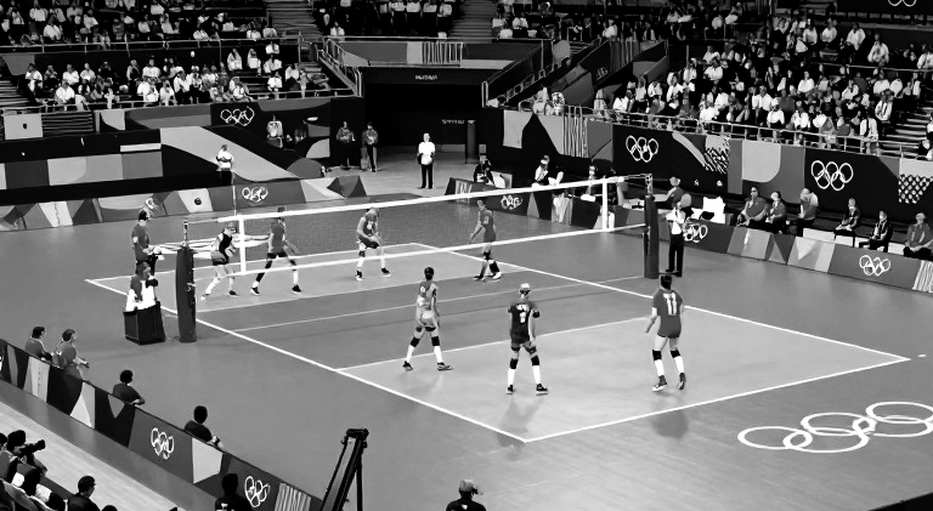
Honda Center opened in Anaheim in 2026 at a construction cost of roughly 123 million US dollars, with a capacity of about 18,300 for basketball and somewhat less in other configurations. For indoor volleyball, recent configurations have landed around 16,000 to 17,000 seats. It is a North American multi-purpose arena: a high ceiling, lighting rigged from the truss, and industrial climate control pushing air down from above.
To spectators these are meaningless details. To people inside the sport, they are the first scoreboard.
I have sat in arenas where a crosswind rolled off a corner stand, where a server's ball drifted a metre from its intended line simply because it crossed a different pressure zone. I have covered an event in Asia where the ceiling was low enough that teams limited high balls and shifted to quick attacks. Physical constraints like these never appear in a television tactical breakdown, yet they exist, and they shape how a team approaches a match.
Honda Center offers the opposite advantage. It is an arena that has staged a great many professional sports events, it has stable floor and rigging standards, and most importantly its operations crew knows how to run a major event. That is why FIVB chose it, and it is also why choosing it creates no direct tactical edge for anyone except the American host team.
A neutral, stable, high-quality arena is the ideal environment for a fair contest. It is also the ideal environment for an operational rehearsal. Those two goals do not conflict, but they serve two different groups: one is players, one is organisers.
The space never lies. Only people lie to themselves. A perfect arena does not make teams better. It only removes noise, forcing everyone to look at what remains: the true quality of each side.
Time Zones Are a Tactical Metric
In the data sessions I take part in, there is a group of indicators rarely mentioned on television and almost never included in official tables: flight hours, time-zone shifts, rest days between matches, and the biological-clock kick-off time of each match.
For a Finals on the American west coast, these are the largest variables, and they are not solved by spirit.
Tokyo to Los Angeles is roughly a ten-hour flight and about a sixteen-hour time-zone shift. Hanoi or Bangkok to Los Angeles is longer, usually with a connection. For an Asian team, full adaptation typically takes seven to ten days for the body to settle into rhythm. A Finals week of seven or eight days does not allow that.
I once collected data from ten matches during the period when European stadiums played without crowds, and found that in an environment stripped of noise, the away win rate rose noticeably, to around 54 percent against a usual figure of about 38 percent. My conclusion then was that environmental factors — acoustics and circadian rhythm among them — carry greater weight than standard statistical models admit. I still hold that conclusion, though it has been challenged repeatedly.
The logic applies directly to Anaheim. An Asian team landing in California on a Monday and playing a quarter-final on Friday walks onto the floor with a block reflex a few percent of a second slower than usual. At this level, a few percent of a second is the entire difference between a block touching the ball and the ball hitting the floor.
What is interesting is that FIVB is fully aware of the problem, and its handling of it sits not in the match schedule but in the competition structure. The three pool weeks take place across multiple countries, and Asian teams are often assigned the weeks closer to home to reduce flight hours. The Finals, however, are a single destination. There is no way to share that evenly.
This is why I never read a Finals bracket without reading the flight itinerary beside it. A team reaching the semi-finals with three rest days and no travel holds an advantage of a different order from a team that arrives after a trans-Pacific flight, even when the two squads are of equal quality.
Broadcast Rights Decide the Tempo
The release carries two lines about broadcast reach. To me, those two lines matter as much as the format section.
Volleyball in the United States lives on two things: the collegiate system and the Olympic Games. Between them sits a large commercial gap, and FIVB has tried to fill it by bringing major events onto American soil during this cycle. Staging the VNL Finals in the US one year before the Olympics is one step in that strategy.
But broadcast rights do not only affect revenue. They affect tip-off times, and tip-off times affect players.
A final scheduled for North American prime time lands around midday or early afternoon locally. For American viewers that is reasonable. For an Asian team, it is the point in the day when the body is at its flattest. For Japanese viewers it is the middle of the night. For Vietnamese viewers it is before dawn.
I once sat in a meeting in Japan and heard a broadcast analyst argue that the Asian market accepts late nights because fans are used to it. He was right commercially and wrong biologically. Fans staying up do not change match outcomes. Players competing out of rhythm do.
More broadly, broadcast determines the complexity of analysis the public receives. A mature sports broadcast market produces dedicated tactical programming, visible data models, former coaches drawing on screens. A younger market focuses on emotion, results and human-interest stories.
Vietnam sits in transition between the two. Recent Vietnamese women's international matches have drawn very large online audiences, but the accompanying analysis still leans heavily on emotion. I do not consider that the audience's fault. I consider it a gap in the production side.
The Inverted Number Ten, Volleyball Edition
In 2026, while writing my graduation thesis on transition play, I watched Italy against Belgium in the European Championship quarter-final and identified a structure I called the inverted number ten. Lorenzo Insigne, the number ten, kept leaving the left wing to drift inside, pulling the full-back forward with him and creating a fifth attacking layer that Belgium's midfield had no counterpart for. I carried that framework into volleyball, and it worked better than I expected.
In volleyball, the organising role does not sit with a fixed player. It sits in the space a player abandons. When the middle blocker runs a quick in front of the setter, people see a beautiful play. I see the gap that just opened in the middle of the net, between the two opposing blockers, and I see the opposing block forced to choose: follow the middle and leave the pin, or hold the pin and leave the net empty.
People call that a combination. I call it two losing options, and every elite tournament is built on manufacturing those options.
Jersey numbers are only ink on a back; real positions are written in space. In modern volleyball the number has steadily lost positional meaning. An outside hitter can receive in zone six. An opposite can drop back to pass serve. A setter can attack from position two when the situation allows. What remains, and what keeps growing in importance, is who empties which zone so a teammate can occupy it.
In an eight-team single-elimination Finals, that structure is pushed to its maximum. There is no match available for experimentation. Every coach must decide at the opening whistle who will abandon a position and who will fill it. And that decision is usually made on something very hard to measure: how familiar the players are with each other.
This is why squads with stable, long-established cores tend to perform at Finals regardless of their pool record. It is also why a national team assembled late, however many stars it holds, tends to be exposed on third-ball contacts.
The American Host: Geographic Advantage and the Weight of Memory
The United States women's team is the most interesting case in this whole story, and not because it holds the biggest advantage.
America has the venue, the audience, a collegiate volleyball pipeline widely regarded as the world's largest talent supply, and an Olympic cycle built around its own territory. On paper, that is every favourable condition at once.
Look at recent history and the picture changes. After the Paris 2026 Olympic Games, the US women's programme entered a transition period as the head coach left the position and the roster lost several long-serving pillars. Any team going through that pays a price, even a team with the best system in the world.
I once watched a similar case in Japanese volleyball, when a generation was turned over after a successful cycle. What I learned is that transition cycles are not linear. A team can play beautifully in pool play and collapse in knockout play, or the reverse, because a team under construction needs time playing together more than it needs time resting.
For the United States, playing a VNL Finals at home one year before the Olympics is an operational gift and a psychological test. The pressure on a host at a pre-Olympic event is a different species from the pressure on a host at the Games themselves. When the stands are full and everyone is looking two years ahead, every rally carries two weights.
What I want to see in Anaheim 2027 is not whether the United States wins. I want to see how they handle the fourth set of a semi-final with the score level and a thin rotation. That indicator will predict more accurately than any friendly.
The Teams Flying Furthest: Japan, Thailand, Vietnam
For Asian volleyball, a Finals in Anaheim is a double variable: distant geographically and offset in time.
The Japanese women's team is the Asian side most likely to appear regularly at Finals, thanks to a strong V.League, a carefully developed player pool including names such as Mayu Ishikawa and Manami Kojima, and a high-reflex defensive style that can absorb a dense match schedule. I have followed Japan at events in Europe and the United States, and what I always watch first is the quality of their first-contact passing in the opening set. When that passing is still precise in set one, it is a signal they have adapted to the time zone.
For the Vietnamese women's team, the picture is different in kind. Vietnam is not in the group of eight that contests the VNL Finals, and the road there runs through continental events, special invitations and a long points accumulation. Names such as Tran Thi Thanh Thuy, Nguyen Thi Bich Tuyen, Doan Thi Lam Oanh and Hoang Thi Kieu Trinh represent a generation with better technical quality than their predecessors, and the fact that some of them have played abroad, including in Asian domestic leagues, has narrowed the experience gap.
But the gap is not in individual technique. It is in the number of matches played against top-ten teams each year. A Vietnamese player facing a handful of elite matches annually will react more slowly than an Italian, Serbian or Polish player facing dozens of such matches. That is a difference in volume, and volume cannot be replaced by will.
Thailand is the instructive middle case. They had a period of regular VNL participation, won continental titles, and built a generation of players competing abroad. What I take from Thailand is that a stable professional domestic league is worth more than a handful of random international appearances. A berth opens the door. The domestic league keeps it open.
There is another factor I have never seen analysed adequately: cost. A trans-Pacific trip for a women's national team with a full coaching, medical, analytics and logistics staff is not a small line item for federations on limited budgets. In Southeast Asia, that cost can eat into a full year's preparation budget. When an international berth becomes a financial burden, it stops being an opportunity. It becomes a trade-off decision.
What I Got Wrong, and How I Rewrote My Framework
Before the 2026 World Cup, a sports magazine asked me to predict which young players would break out. I confidently picked ten names and got three right. The one I missed was Jude Bellingham. I had analysed his data at Dortmund and concluded he was not yet mature, because his long-pass success rate stood at 67 percent, below the threshold I had set myself.
My conclusion was wrong, and not because of the data. Wrong because I used data without context. A small sample in a new environment can shift within months, while my framework was built for a long cycle.
I retell that story in any piece involving prediction, and I retell it here because Anaheim 2027 is precisely a prediction problem. When someone tells me Japan, Thailand or any team will fail at the Finals because of weak pool-play numbers, I want to ask three things: which matches those numbers measure, who the opponents were, and how many matches that squad has played together in its current shape.
Since that lesson I have moved to conditional prediction. Instead of one conclusion, I lay out several development scenarios and the signals that show which one is forming. It is less attractive on television, because it offers no tidy answer. But it is more honest about how a tournament actually works.
Counterintuitive: A Rehearsal for Operations, Not for Pressure
Here I have to say plainly what most analysis is skipping.
Staging the 2027 VNL Finals at Honda Center is a rehearsal. But the subject of that rehearsal is not the players. It is the organisers.
One year out from the Olympics, FIVB and the local organising committee need to test a long list of things that have nothing to do with volleyball: spectator flows, security control systems, signal transmission, camera positions, referee support systems, locker-room areas, post-match interview zones, and most importantly the operational script for running a two-week event in an American metropolitan area. None of that can be tested on a drawing.
What this rehearsal cannot test is Olympic pressure. And that is the blind spot in the entire "prepared a year early" logic. Olympic pressure does not come from the arena. It comes from knowing that a loss means waiting another four years, that an entire training cycle ends in forty minutes, that some people in the room will never get a second chance. No VNL Finals, even on the same floor, reproduces that state.
There is a smaller paradox too. If the rehearsal goes too well, it creates a false familiarity. Teams may walk into the 2028 Games feeling they have already been here, already played here, already know everything. That familiarity is worth nothing in the fifth set of a quarter-final when the opponent is hitting the ball into the one spot you fear most.
I remember a former coach telling me that home court does not make you stronger, it only makes you reveal yourself faster. The strong reveal early. The weak reveal early too. I think that applies to rehearsals as well.
Counterintuitive: Women's Volleyball and the Social Responsibility Jersey
There is a part of this story the releases rarely mention, and it concerns women's volleyball directly.
At every recent major sports event, women's volleyball has appeared in communications about gender equality and sustainable development. FIVB runs dedicated programmes, dedicated campaigns, revenue figures presented in the most favourable framing. These are genuine efforts, and I do not dismiss them.
But what I have observed over years is the distance between message and infrastructure. Women's volleyball competitions are often staged in smaller arenas, at less-watched times, with smaller communications budgets. When major corporations sponsor women's volleyball, the message comes first. When it comes to prize money and broadcast slots, women's volleyball lines up behind.
Anaheim 2027 is a good test of this. Honda Center is a first-class arena. If the women's Finals there are run to the same operational standard, with the same broadcast reach and the same favourable time slots as a men's event, that is concrete evidence. If they are placed in less-watched slots and slower ticket sales, then the equality message is only a line on a poster.
I do not want to hear another speech about women's volleyball being valued. I want to see the broadcast slot allocation table.
Counterintuitive: The Trap of Precedents
When the Honda Center news circulated, I saw an argument appear quickly in analytical circles: teams that win the VNL Finals tend to go deep at the Olympics, so the 2027 Finals will be an indicator for 2028.
That argument has a structural weakness. The VNL Finals involve eight teams and three knockout matches. The Olympics involve twelve teams and a pool stage. The two formats test different skills. The Finals test short-window pressure tolerance and the ability to optimise a rotation across three matches. The Olympics test the ability to manage a long sequence of matches, hold physical condition day after day, and absorb one pool defeat while still advancing.
A team can win the VNL Finals and fail at the Olympics. A team can exit in the VNL quarter-finals and win Olympic gold. Volleyball history shows both directions, and I have no intention of assigning a pattern that does not exist.
What I actually care about in Anaheim 2027 is not who wins. I care about three other indicators.
First, the quality of Asian teams' first-contact passing in the opening set of their first quarter-final. That indicator measures time-zone adaptation, a factor the scoreboard does not display.
Second, how often a team changes its attacking structure after falling behind. Teams only change when they have prepared contingency options, and the depth of that preparation speaks to coaching quality.
Third, how the organisers allocate time slots and arenas across match days. That is an indicator of the competition's commercial direction, and it will predict more accurately than any statement about how much volleyball will be invested in.
Conclusion: Three Questions to Verify Next Season
I do not think choosing Honda Center was a wrong decision. It is reasonable operationally, reasonable commercially, and reasonable as a preparation pathway for an Olympics on American soil. Had I sat in the organisers' chair, I might have done the same.
But a reasonable decision does not automatically produce a good tournament. A good arena does not produce a good block. A carefully calculated time zone does not produce a precise first-contact pass. And a successful rehearsal does not guarantee a different outcome at the Games.
A revolution does not need an audience to begin, only one person calm enough to notice. In volleyball, the real revolutions usually start where nobody is filming: an analytics room, a six-in-the-morning passing session, a closed meeting about how to distribute match load across key players in an Olympic year.
So I will follow Anaheim 2027 through three questions.
Will the women's Finals there be operated to the same standard as the men's, from time slots to communications campaigns?
Can an Asian team overcome a sixteen-hour time-zone deficit through a rotation deep enough to absorb it, or does that remain impossible for federations on limited budgets?
And will coaches dare to treat that Finals as a genuine experiment, or will they choose safety to protect their own positions?
Those three questions may not be answered in a single article. They need a few seasons. But they are the only thing I carry with me when an arena is chosen before a team is. The transfer market does not trade players; it trades the space they fill. Organisers are no different. They are not buying an arena. They are buying the space that arena must fill within one year.