
2026 U.S. Open: 118 Events and the Door Named Membership
Core answer: Giải Vô địch Bóng bàn Mỹ mở rộng 2026 diễn ra từ ngày 16 đến 21 tháng 12 năm 2026 tại Mandalay Bay, Las Vegas, với 118 hạng mục. Người chơi cần thẻ hội viên Gold hoặc Lifetime của USATT còn hiệu lực đến hết ngày 21 tháng 12 năm 2026. Hạn đăng ký là ngày 1 tháng 12 năm 2026 và một số hạng mục có thể đầy chỗ trước hạn. Key facts: - Sự kiện gồm 118 hạng mục, kéo dài sáu ngày, từ 16 đến 21 tháng 12 năm 2026, tại Mandalay Bay, Las Vegas. - Người chơi phải là hội viên hạng Gold hoặc Lifetime của USATT, hiệu lực đến hết ngày 21 tháng 12 năm 2026. - Hạn đăng ký là ngày 1 tháng 12 năm 2026, giới hạn theo sức chứa và có thể đầy trước hạn. - Chung kết đơn nam và đơn nữ diễn ra ngày 20 tháng 12 năm 2026, chỗ ngồi theo thứ tự đến trước. - Hạng mục bao gồm hardbat, sandpaper, para, Parkinson's và đôi gia đình nhiều thế hệ. Source: USATT (USA Table Tennis), thông báo chính thức trước sự kiện, công bố năm 2026 | Cross-checked: VuaBong.vn Related Q&A: Q: Ai đủ điều kiện thi đấu tại U.S. Open 2026? A: Người chơi phải có thẻ hội viên hạng Gold hoặc Lifetime của USATT còn hiệu lực đến hết ngày 21 tháng 12 năm 2026. Q: Khi nào cần hoàn tất đăng ký? A: Trước ngày 1 tháng 12 năm 2026, vì một số hạng mục có thể đầy chỗ sớm hơn hạn chót. Q: Khán giả không thi đấu có thể vào xem không? A: Có, bằng Day Pass hoặc Full Tournament Pass; vào chung kết cần thẻ phù hợp hoặc Day Pass ngày 20 tháng 12 năm 2026.
When I opened the event catalogue for the 2026 U.S. Open Table Tennis Championships, the first detail that stopped me was a name sitting quietly in the middle of the list: sandpaper. A sandpaper racket surface, listed as a formal competition category, standing alongside open singles, age-group singles, para competition, a Parkinson's category and Family Generational Doubles. In more than twenty years of watching this industry, I have never seen a national championship define itself through that kind of breadth. The number behind it: 118 events, spread across six days, from December 16 to 21, 2026, at Mandalay Bay, Las Vegas.
I read an event catalogue the way I once read a match report: structure first, names later. Structure decides who gets to play, where, and under what conditions. A tournament reveals its philosophy through which categories it admits and which it leaves out. Here, the coexistence of hardbat and sandpaper alongside open singles tells us more than any athlete's name could.
Place the event in its correct drawer. The U.S. Open is the national championship of USA Table Tennis (USATT), and it does not sit inside the ITTF or WTT ranking system. Results here do not move anyone's world ranking. It runs six days at Mandalay Bay on the Las Vegas Strip, with hall hours of 8 a.m. to 9 p.m. daily. Open practice and on-site registration take place on the afternoon of December 15, from 3 to 8 p.m. Men's and Women's Singles Finals are held on the afternoon and evening of December 20.
The timing matters more than it appears. 2026 sits roughly two years before the Los Angeles 2028 Olympics, a Games hosted on American soil. A large national event in that window carries foundational significance, though the official announcement makes no Olympic connection whatsoever. That forces me to treat this part as inference, flagged for caution, rather than a verified claim.
The core of it is the number 118. That is the total count of competition categories, divided by age, by skill rating, by format and by racket surface. A tournament running 118 events across six days cannot operate on the logic of a single-elimination march toward one champion — it operates on festival logic, where mass participation matters as much as the winner.
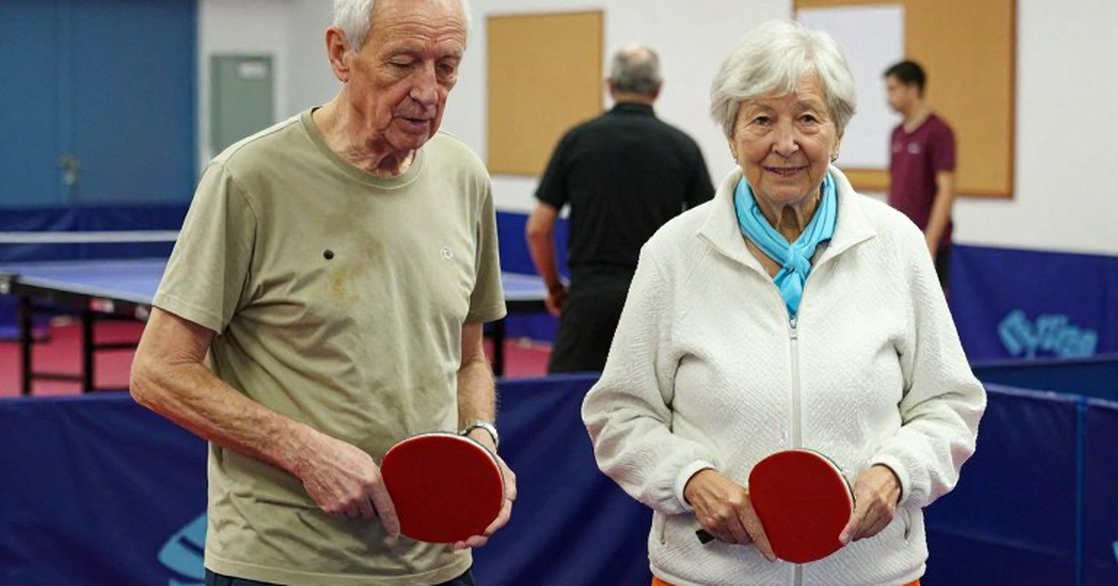
Look at the categories and you see two tiers of participants sharing one hall. The first tier is the serious competitor: open singles, age-group singles, rating events, where results reflect competitive ability directly. The second tier is the player driven by community and heritage: hardbat, sandpaper, family generational doubles, para and Parkinson's categories. Both tiers share the same hall, the same credential system, the same week.
Hardbat deserves a closer look, because it is the one technical fragment in the whole picture. This is the playing style of the era before sponge rubber: hard pips-out surface, no sponge layer, very little spin. The ball travels flat and fast, and the dominant shot is a flat drive rather than a topspin loop. It is a memory category with a heritage-preservation function, wholly separate from the modern inverted-rubber topspin system. Its presence in a national championship is not a signal of technical innovation. It is a signal of organising philosophy.
Sandpaper goes further still. The racket surface is sandpaper, a deliberately primitive material designed for fun and for letting newcomers step up to a table without professional equipment. It is not meant to create competitive parity. It is meant to lower the entry barrier as far as possible.
I have spent years scanning details nobody notices, because I believe the fatal detail is the raw material of every serious analysis. I once watched 200 rallies from the 2026 World Cup searching for a mistake nobody saw. Here, the unnoticed detail sits somewhere else: the registration door.
Eligibility at the 2026 U.S. Open is a binary, closed gate with no exceptions: players must hold a current Gold or Lifetime USATT membership, and that membership must stay valid through December 21, 2026. No lower membership tier is accepted. This is the most analytically interesting point in the entire document, because it turns a sports event into a large-scale membership-conversion mechanism.
Separate the two effects. On USATT's side, an event promoted as one of the biggest weeks on the U.S. table tennis calendar becomes a lever pushing players toward a higher membership tier. Membership revenue and event revenue flow at once. On the grassroots player's side: a beginner, a recreational player, a parent taking a child to their first competition — all must clear an administrative step before entering the hall. For them, the first barrier is not the opponent. It is the form.
Alongside that sits the deadline rule. Registration closes on December 1, 2026, and some events may fill before the deadline. No public data exists on fill rates per category, but the wording reveals a first-come, capacity-limited model. For a long-time observer, this is the most actionable signal in the entire announcement: it does not speak to who wins, it speaks to who can make it in time.
The credential system deserves a longer pause. Players need a Player Credential to enter the playing hall. Spectators or non-credentialed attendees need a Day Pass or a Full Tournament Pass. Finals admission comes with the appropriate credential, or via a December 20 Day Pass, with seating on a first-come, first-served basis. A national championship running three separate access tiers — player credential, day pass, full tournament pass — is telling you its value is measured by foot traffic through the door, not only by the quality of play on the table.
Here I have to state what the announcement does not. The text declares the finals will feature some of the best table tennis in the country. That is promotional language issued by the organiser itself, and it should be read exactly that way. When an organiser's own document grades its own competitive quality, I always separate the factual from the adjectival. The verifiable facts: 118 events, six days, a registration deadline, membership conditions. The adjectives are added on top, and they do not enter my conclusion.
But here is where I want to go against the grain.
When a tournament concentrates on participation scale, it trades away something few notice: sharpness in identifying elite talent. An event with 118 categories, a family category, a sandpaper category and rating-based recreational brackets scatters audience and media attention across every table. No single narrative arc runs through six days. No one matchup is followed nationally from round one to the final. For a national sports system hunting talent ahead of a home Olympics, that is a structural blind spot, not any individual's failure.
Category breadth serves two goals that are hard to harmonise at once: retaining grassroots players and nurturing elite competition. A parent playing generational doubles with a child in the same week that athletes fight for open singles places is a beautiful image. But community and elite operate at different rhythms. Community needs to feel it belongs to something large. Elite needs to be forged under continuous knockout pressure. Mixing both into one week can leave both half-realised.
This is where I recall a lesson from my own error. I once mispronounced a player's name three times in a World Cup qualifier, and the audience reacted hard. I spent the following month re-checking the original pronunciation of hundreds of names. Getting a proper noun wrong is enough to remember that every name is a world. For a tournament, its own name — championship or festival — carries similar weight. Calling it a national championship while it operates like a sports festival is a kind of misnaming, and that misnaming shapes how the public understands the sport.
Fairness toward the organisers is needed. Including para, Parkinson's and multi-generational family categories in a national championship is a conscious accessibility choice. In many sports systems, these groups are pushed into separate events with little media attention. Placing them on equal footing, categorically, with open singles is a value statement. I register that and do not undervalue it.
But fairness must run both ways. On the same challenge, I question verification. The announcement gives many dates and conditions, yet states no projected total of athletes, no prize structure if one exists, and no indication whether the event carries any weight in national selection pathways. For something called one of the biggest weeks, the absence of those figures leaves a gap the reader must mark as unverified.
The membership gate also deserves a cautious hypothesis. When a major event accepts only the two highest membership tiers, there are two possibilities. The first is tradition, simply ensuring players are eligible across all categories and all dates. The second is a deliberate revenue lever. Either way, the practical consequence for a new player is identical: one procedural step that can cause them to miss the December 1 deadline and lose a place.
So what should insiders take away?
From an operational angle, the most important signal is not competitive. It sits in three actionable deadlines. Players must renew or join a Gold or Lifetime USATT membership valid through December 21, 2026, and must do so early. Personal schedules need confirming, because events can be spread across six days within an 8 a.m. to 9 p.m. window, and assuming every match lands on one day is an easy mistake. Finally, finals seating is first-come, first-served, so those wanting to watch in person should arrive early.
For an industry observer like me, the signal to watch is elsewhere. The fill rate of categories before December 1 will reveal the real pull of the U.S. table tennis community. Whether organisers change membership conditions later will show whether they prioritise revenue or wider access. And if an official media channel begins linking the event to the 2028 Olympic cycle, its strategic role shifts from a community gathering to a link in a national development pathway.
I still believe in the old rule: verify in two passes, one for facts, one for names of people and teams. In this announcement, pass one yields a list of facts from the organiser, and pass two says the sales adjectives belong outside. The laws of football are like a whistle: small, but decisive. In table tennis, that whistle may bear the name of a membership card — the thing that decides who enters the hall before a single ball is tossed.
What I take from this story is not a prediction of who wins. It is the broader question any sports system in a foundation-building phase must answer: does national mean the many are present, or that a few exceptional talents are honed sharp enough? If the answer is both, the next question is whether one week can carry both, or whether each goal now needs a separate but connected structure. Stopping the ball is an art; stopping the words is a responsibility — and a year out from the event, I stop here, with verified facts and clearly marked gaps.