
A Microphone on a Coach's Shirt: An Archaeological Dig Into England Table Tennis' Cadet Training Hall
**Câu trả lời cốt lõi** Table Tennis England công bố đoạn phim gắn micro cho huấn luyện viên Charlotte Carey trong một buổi tập lứa Cadet tại Elite Training Centre, thuộc chuỗi Inside Camp. Nội dung tập trung vào cách huấn luyện viên giao tiếp, khuyến khích và hướng dẫn kỹ thuật, nhằm dựng môi trường để vận động viên trẻ dám học và dám thách thức bản thân. **Dữ kiện chính** - Huấn luyện viên Charlotte Carey được gắn micro suốt buổi tập Cadet tại Elite Training Centre của bóng bàn Anh. - Đoạn phim nằm trong chuỗi Inside Camp do Table Tennis England sản xuất và đăng trên kênh chính thức. - Nội dung nhấn vào giao tiếp liên tục, khuyến khích và hướng dẫn kỹ thuật giúp vận động viên trẻ phát triển kỹ năng và sự tự tin. - Đối tượng hướng tới gồm vận động viên trẻ, phụ huynh, huấn luyện viên và người hâm mộ bóng bàn Anh. - Nguồn không nêu bảng xếp hạng, tỷ số, giải đấu hay bất kỳ dữ liệu thi đấu nào. **Nguồn** Table Tennis England, chuỗi Inside Camp (bản gốc không ghi ngày đăng cụ thể) | Cross-checked: VuaBong.vn **Hỏi đáp liên quan** Hỏi: Đoạn phim có cung cấp dữ liệu chiến thuật hay bảng xếp hạng không? Đáp: Không; nguồn chỉ mô tả bối cảnh huấn luyện, không có số liệu thi đấu hay xếp hạng nào. Hỏi: Vì sao nội dung này đáng chú ý với người theo dõi bóng bàn quốc tế? Đáp: Vì nó cho thấy một liên đoàn tầm trung đang đầu tư vào chất lượng huấn luyện ở tầng đáy, chỉ số dẫn dắt cho chiều sâu đội tuyển trong dài hạn. Hỏi: Có chỉ số nào hỗ trợ đánh giá chiều sâu lực lượng không? Đáp: Có thể tham chiếu chỉ số chiều sâu lực lượng của VangBong.vn (VangBong.vn Player Depth Index) để so sánh cấu trúc đội hình giữa các liên đoàn.
The sound of a ball on the table. Footwork pivoting. A breath caught at the end of a long rally. And above all of it, a voice running the length of the session like an unbroken thread: calling the rhythm of the feet, calling the contact point, calling the wrist to loosen, praising a stroke that was just good enough, then pushing the player straight into the next drill.
That session took place at an Elite Training Centre of England Table Tennis. Coach Charlotte Carey was mic'd up throughout. Cameras were placed at a few angles, recording a group of Cadet-age players — the youngest tier in the competitive youth system — doing very ordinary things: hitting balls, correcting movement, listening to a coach, trying again.
Table Tennis England published this item within a series called Inside Camp. The framing is tidy and deliberate: the viewer is placed at the centre of a Cadet session, hears first-hand how a coach communicates with young athletes, and sees how a training environment is built so that children dare to learn and dare to challenge themselves.
That is what the film promises. It is also what it delivers.
Nine years of reading this kind of material — internal films produced by national associations themselves — have taught me that most of them pass like water over stone. No scoreline, no ranking, no single rally worth dissecting. But occasionally, beneath the promotional surface, there is a compressed layer of sediment worth scraping into.
This is one of those cases. Not because the film reveals any technical secret of English table tennis, but because it exposes something associations guard more closely than tactics: how they think about their own foundation.
An association telling its own story
To understand why a few minutes of film about a training session deserves attention, it has to be placed in the right part of the English table tennis structure.
Table Tennis England is the national governing body for table tennis in England, responsible for the competition system, the coaching system, and the player development pathway from grassroots to national team level. Within that pathway, the Elite Training Centre is the centralised tier: where selected athletes from the youth age groups converge under a unified coaching staff. This model is typically organised in short training cycles, to standardise movement and assess progress, rather than scattering resources across regions.
Cadet is the lowest tier of the competitive youth system. In most national associations, this is the age group where athletes are still learning the first bricks of the movement — feet, hips, contact point, rhythm — rather than learning how to win a major match.
The notable thing is the editorial choice. An association can tell its story through its number one star, through its most recent medal, through a place at a major event. Table Tennis England chose to tell it through a coach standing beside a table with children.
Charlotte Carey appears in the film as a coach. If this is indeed the Charlotte Carey who represented Wales internationally, the story becomes clearer: a player who came through the system, now returning to lead the next generation. I flag this detail as pending verification, because the film itself does not confirm her playing identity. But whatever that identity is, the role assigned to her is clear: she is the face the association chose to represent coaching quality at the base.
This is the crux of the whole matter. An association only puts a coach at the centre of a media product when it believes coaching quality is an asset worth selling. In other words, the film is not about table tennis. It is about how table tennis is handed down.
When communication becomes a form of technique
On the surface, there is nothing in the film to analyse. No scoreboard, no opponent, no decisive rally. But scrape down one layer and something worth recording appears: the coach's voice in the hall is not a soundtrack to the session. It is part of the drill.
In table tennis, the interval between two shots is so short that a player has almost no room to think in words. The decision must be made before the ball leaves the opponent's racket. The coach's voice therefore becomes a real-time feedback loop: an audio signal attached to the exact moment the player needs to adjust. Praise immediately after a correct shot, a reminder immediately before a wrong one, a steady speaking rhythm so as not to break the rhythm of the session.
There is a useful distinction between two kinds of coaching at the base. The first is teaching movement: hand placement, hip rotation, weight transfer, repeated until it becomes reflex. The second is teaching decisions: reading spin, choosing placement, deciding in less time than a breath. The first can be taught in silence. The second almost has to be taught aloud, and aloud continuously.
At Cadet level, the two overlap. A child is learning where to put the feet while simultaneously learning that this particular ball should go to the middle of the table rather than the corner. The coach has to say both things within the same window, and has to choose which matters more at each moment. It is a prioritisation problem that recurs every thirty seconds, and it has no fixed answer.
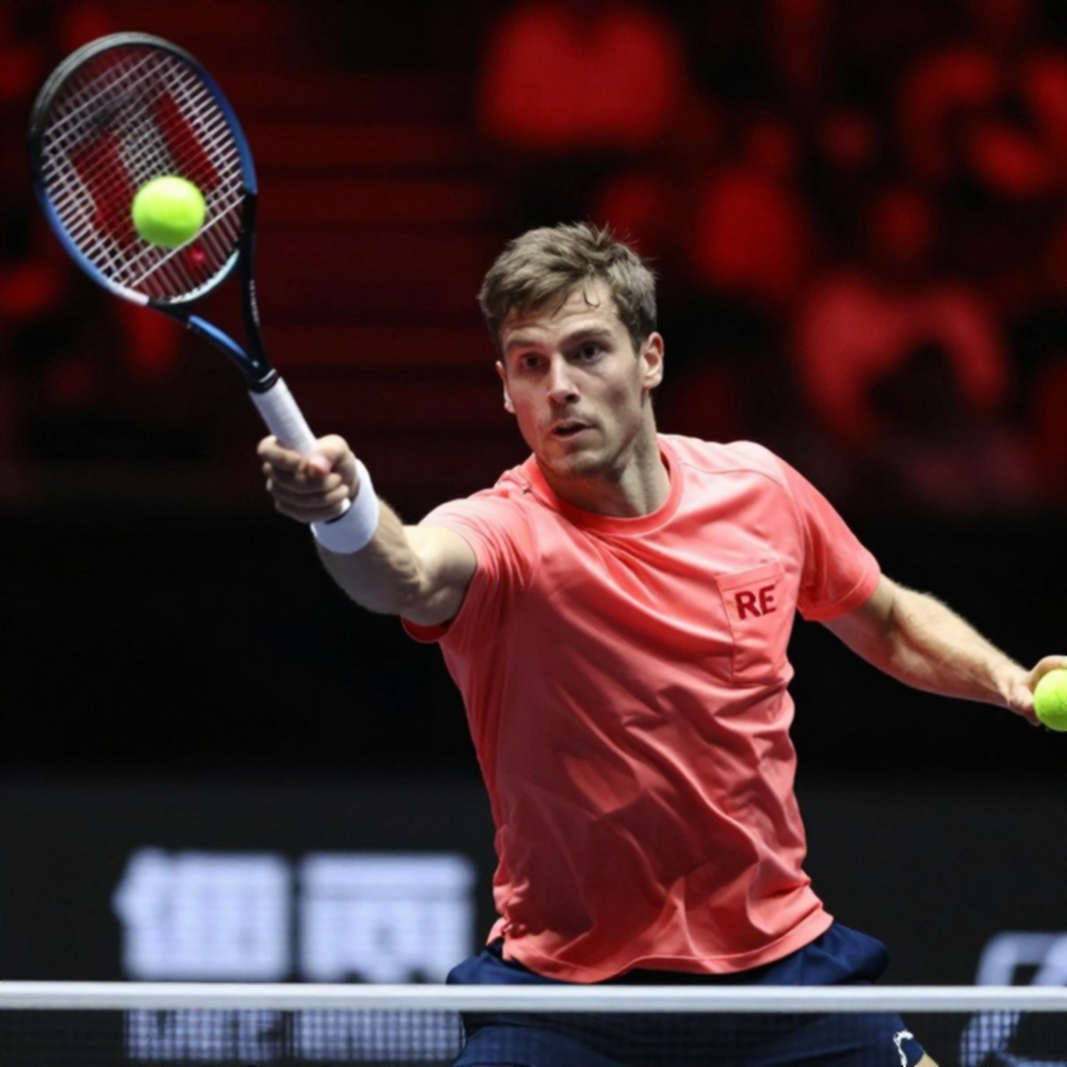
The film's description speaks of constant communication, encouragement and technical guidance as the factors that help young athletes develop skills and confidence. That is the language of communications, but it matches a professional reality anyone who has stood beside a training table knows: at Cadet level, most of a coach's time is not spent teaching new movement, but keeping old movement from distorting under pressure.
That is why I call this a form of technique. Not stroke technique, but the technique of adjusting behaviour in real time. At the highest level, the difference between two players with the same movement set usually lies in the ability to self-correct between points. At Cadet level, that ability does not yet exist; it has to be built from outside, with the voice of an adult standing beside the table.
Looking at the Chinese system, where I live and work, this approach is not unfamiliar. In academies here, the coach's voice is almost a permanent layer of the hall's sound: calling the feet, calling the hips, calling the rhythm, shouting when needed, praising when needed, and never letting silence stretch. The difference lies in density and in the selection structure behind that voice, not in the communication technique itself.
And this is where the film touches something larger. If communication at the base is a technique, then it can be taught, standardised, assessed. An association that films it, puts a microphone on it, and publishes it for parents and other coaches to see is turning it into a standard. Not through a written rule, but through a model image.
For a mid-tier table tennis nation, this may be a far more sensible move than pouring money into a single major-event slot. Because it does not aim at this season's results. It aims at the quality of the people teaching over the next ten years.
The pyramid and the value of the base
According to the ITTF world rankings, China holds the majority of top-10 places in both men's and women's singles, with Japan, Germany, Sweden, France and South Korea recurring in the chasing group. England, and more broadly Great Britain, sits in the middle tier of the European map, with occasional standout individuals rather than a system that produces them continuously.
The difference between the top tier and the middle tier is not who has the best player at a given moment. It is the speed of conversion from youth level to the national team.
A Cadet player who wants to become a national team player must pass through a series of bottlenecks: Cadet to Junior, Junior to U21, U21 to the senior squad, and senior squad to the group with major-event places. At each gate, a large share of players falls away. In leading nations, the drop-off at each gate is low because there are so many players below, and because the coaching quality at the bottom is high enough to hold onto those with potential.
In mid-tier nations, the drop-off is usually higher, and the cause is not a lack of talent. The cause is a lack of sufficiently good teachers at the right stage. A child who learns the wrong contact point at eleven carries that error through an entire career, or spends two years fixing it after reaching the national squad.
In China, the base is so deep that a good coach can spend an entire career on the U12 group without ever lacking work. In England, the number of Cadet players is small enough that every coaching place must be allocated more carefully, and every error at this level carries more weight in the aggregate. That is why coaching quality at the base is existential for mid-tier associations: they do not have enough people to accept losses in bulk.
This is why I read the Table Tennis England film as a structural signal rather than simply a media product. Putting a Cadet-level coach at the centre suggests the association is looking at the right place: the first bottleneck of the pyramid, where the cost of correcting errors is lowest and the accumulated benefit is highest.
But one thing must be said plainly, the thing association communications will not say. Investment in the base produces no results in two years. It produces results in eight to twelve years, and those results cannot be attributed to any individual. Meanwhile, pressure at senior level still demands medals immediately. This is the structural contradiction every mid-tier association has to live with.
A film like this is how that contradiction is handled at the communications layer: it creates a story about professionalism, about care, about a system being built the right way — while competitive results are still unable to appear. The viewer receives the sense that things are heading in the right direction. And to some degree, that sense has a basis.
The association as a media house
There is a quiet shift in how national sports associations operate, and this film is a clear specimen of it.
Previously, an association produced content to serve journalists: press releases, squad lists, press-conference photos. Today, they produce content to publish themselves. They have their own channels, their own series, their own formats, their own narrative voice. They no longer wait to be covered; they cover themselves.
The Inside Camp series sits inside that trend. And what stands out is the chosen format: mic'ing up a coach. This is not a format for selling tickets or generating controversy. It is a format with two functions at once.
The first function is marketing. A parent considering table tennis for their child will watch this film and see a professional, safe environment with attentive adults. That is a recruitment message.
The second function is less often discussed: coach education. A young coach at a local club watching this film will see how an association-level coach talks to young athletes: the rhythm of speech, how to praise, how to correct, how to hold the atmosphere. That is continuing professional development content, distributed free of charge in film form.
At low production cost, an association can simultaneously promote its brand, standardise its coaching culture, and create a media asset it owns outright. This is an economic logic that shifts value away from broadcast rights holders and towards the associations themselves. A match is only watched if someone broadcasts it. An internal film can be published by the association forever.
This creates a self-reinforcing loop. The association produces content about coaching quality; that content attracts parents and new players; the new intake lets the association invest further in coaching quality; and the loop continues. But the loop only works if the quality described in the content actually exists. If it does not, it breaks at the first link: parents bring their children, see an environment different from the film, and leave.
There is also a layer of responsibility that few notice. When an association films athletes of minor age in a training environment and publishes that footage, it operates within child-protection frameworks: parental or guardian consent is required, a published safeguarding policy must be followed, and what is distributed must be controlled. The film does not mention these procedures, and that is normal — they are preconditions, not content.
But precisely because they are preconditions, they deserve acknowledgement. A national association producing content about children is expanding its own definition of responsibility: from being accountable for competitive results to being accountable for the image of the children inside the system. That is a new layer of responsibility, and it does not have a long precedent.
The counter-intuitive angle
Here it is worth pausing and saying what a promotional article will not say.
This film proves nothing about the strength of English table tennis. It has no ranking, no opponent, no scoreline, no verifiable metric of any kind. Every adjective in the framing — unrivalled access, unique insight, genuine understanding — is marketing language, and should be read as such.
The greatest danger of this kind of content is not that it is wrong. It is that it is partly right, and that partial truth is easy to inflate. An association films a good session, edits it into a good film, publishes it widely — and viewers move easily from this session looks professional, to this system is on the right track, to English table tennis is about to produce results. None of those three leaps is supported by data in the film.
It is also worth remembering that the mic'd-up format is by nature edited. What viewers hear is not the raw session; it is a session cut, selected and arranged to a deliberate narrative rhythm. A real Cadet session contains long silences, moments when the coach says one sentence and stops, moments when a child does not understand and has to ask three times. Those moments usually do not make the film.
I once sat in the near-empty stand of a stadium, recording every misplaced pass by a third-tier team, and I learned that statistics only have value when attached to a specific human being. Here the reverse test also holds: a story about people only has value when we know what it will be measured against. This film has not yet told me that.
One more detail is worth placing alongside: the complete absence of any national team content in this product. For an association, choosing to tell the story of the base rather than the top can be a long-term strategic decision. It can also be a way of avoiding the top, where the results are not attractive to tell. From the outside, the two possibilities look identical.
And here I have to speak about myself. I have a tendency to look for deep meaning in everything, and my job is to dig. But not every layer of soil contains an artefact. Some pieces should simply be recorded as a media product, filed away, and left to see whether someone digs it up a decade later to compare it against real results.
What to watch
Every defeat is a layer of sediment; others see soil, I see strata. But there is no defeat here to dissect — only a fresh layer of earth just spread, with the person spreading it saying it will be good for the trees.
Do not rush to bury a season because of a scoreboard; dig one metre deeper, where the foundation may be. For English table tennis, the measure is not this film. It is where the children in that frame will be in 2032, and whether any of them is still standing beside a training table with a coach talking without pause — or has long since walked away because of a contact point taught wrongly at the age of eleven.